
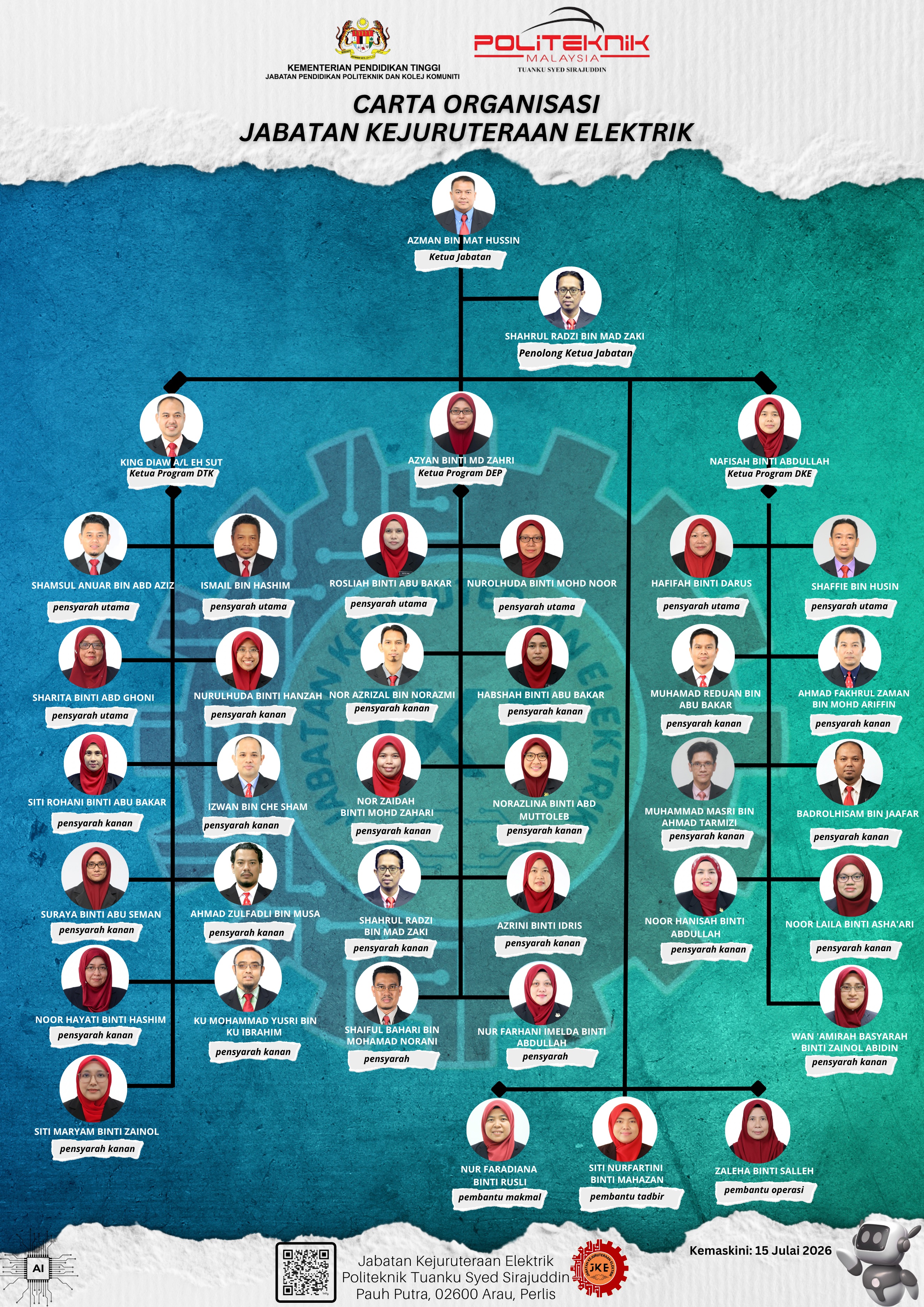
Electrical Engineering Department was lead by Mr. Shahrul Radzi bin Mad Zaki @ Abdullah as Head of Department and assist by Head of Programme which are Mr. King Diaw A/L Eh Sut (Diploma in Electronic Engineering (Computer)), Madam Azyan binti Md Zahri (Diploma in Electronic Engineering (Telecommunication)) and Madam Nafisah binti Abdullah (Diploma in Electronic Engineering) with 28 lecturers and 2 supporting staffs. All programmes offered by Electrical Engineering Department is a full-time programme comprising of six semesters course work with one full semester of industrial training built-in. Students are prepared for their future role in the economy by building a solid foundation in technical knowledge and necessary skills which relates to the field of electronic engineering. Apart from the technical knowledge and skills, all the programme offers by Electrical Engineering Department also emphesizes on the development of the individual potential of students in an integrated and holistic manner through courses such as Islamic studies, moral studies, co-curiculum, soft skills and entrepreneurship.
ORGANIZATION CHART
STAFF INFORMATION
| No. | Name | Designation | Phone Ext. ( 04 988 6200 ) |
E-mail ( @ptss.edu.my ) |
| 1 | Shahrul Radzi bin Mad Zaki @ Abdullah | Head of Department | 6233 | shahrul |
| 2 | King Diaw A/L Eh Sut | Head of Programme (DTK) | 1803 | kingdiaw |
| 3 | Azyan binti Md Zahri | Head of Programme (DEP) | 6230 | azyan |
| 4 | Nafisah binti Abdullah | Head of Programme (DKE) | 1802 | nafisahabd |
| 5 | Ahmad Zulfadli bin Musa | Senior Lecturer | 6235 | ahmadzulfadli |
| 6 | Habshah binti Abu Bakar | Senior Lecturer | 1808 | habshah |
| 7 | Hafifah binti Darus | Senior Lecturer | 1808 | hafifah |
| 8 | Ismail bin Hashim | Senior Lecturer | 6235 | ismail.hashim |
| 9 | Muhamad Reduan bin Abu Bakar | Senior Lecturer | 6235 | reduan |
| 10 | Noor Laila binti Asha’ari | Senior Lecturer | 6237 | noorlailaashaari |
| 11 | Nurolhuda binti Mohd Noor | Senior Lecturer | 1808 | nurolhuda |
| 12 | Rosliah binti Abu Bakar | Senior Lecturer | 1808 | rosliahabubakar |
| 13 | Shaffie bin Husin | Senior Lecturer | 6235 | shaffie |
| 14 | Shamsul Anuar bin Abd Aziz | Senior Lecturer | 6238 | shamsulanuar |
| 15 | Sharita binti Abd Ghoni | Senior Lecturer | 6237 | sharita |
| 16 | Ahmad Fakhrul Zaman bin Mohd Ariffin | Lecturer | 6235 | ahmadfakhrul |
| 17 | Azrini binti Idris | Lecturer | 6237 | azriniidris |
| 18 | Badrolhisam bin Jaafar | Lecturer | 6235 | badrolhisam |
| 19 | Izwan bin Che Sham | Lecturer | 6235 | izwan |
| 20 | Ku Mohammad Yusri bin Ku Ibrahim | Lecturer | 6237 | kmyusri |
| 21 | Meor Ahmad Zainal bin Meor Muhamud | Lecturer | 6237 | meor |
| 22 | Muhammad Masri bin Ahmad Tarmizi | Lecturer | 6234 | masri |
| 23 | Noor Hanisah binti Abdullah | Lecturer | 6237 | noorhanisah |
| 24 | Noor Hayati binti Hashim | Lecturer | 6237 | noorhayati |
| 25 | Norazlina binti Abd Muttoleb | Lecturer | 6234 | norazlinaam |
| 26 | Nur Farhani Imelda binti Abdullah | Lecturer | 1836 | nurfarhani |
| 27 | Nurulhuda binti Hanzah | Lecturer | 1864 | huda |
| 28 | Shaiful Bahari bin Mohamad Norani | Lecturer | 6235 | sbahari |
| 29 | Siti Maryam binti Zainol | Lecturer | 1808 | sitimaryam |
| 30 | Siti Rohani binti Abu Bakar | Lecturer | 1808 | srohani |
| 31 | Suraya binti Abu Seman | Lecturer | 1808 | suraya.abuseman |
| 32 | Wan ‘Amirah Basyarah binti Zainol Abidin | Lecturer | 1808 | wanamirah |
| 33 | Nur Faradiana binti Rusli | Lab Assistant | 6235 | faradiana |
| 34 | (Kosong) | General Service Assistant | 6235 | – |
- Diploma in Electronic Engineering (Computer) (DTK)
- Diploma in Electronic Engineering (Telecommunication) (DEP)
- Diploma in Electronic Engineering (DKE)
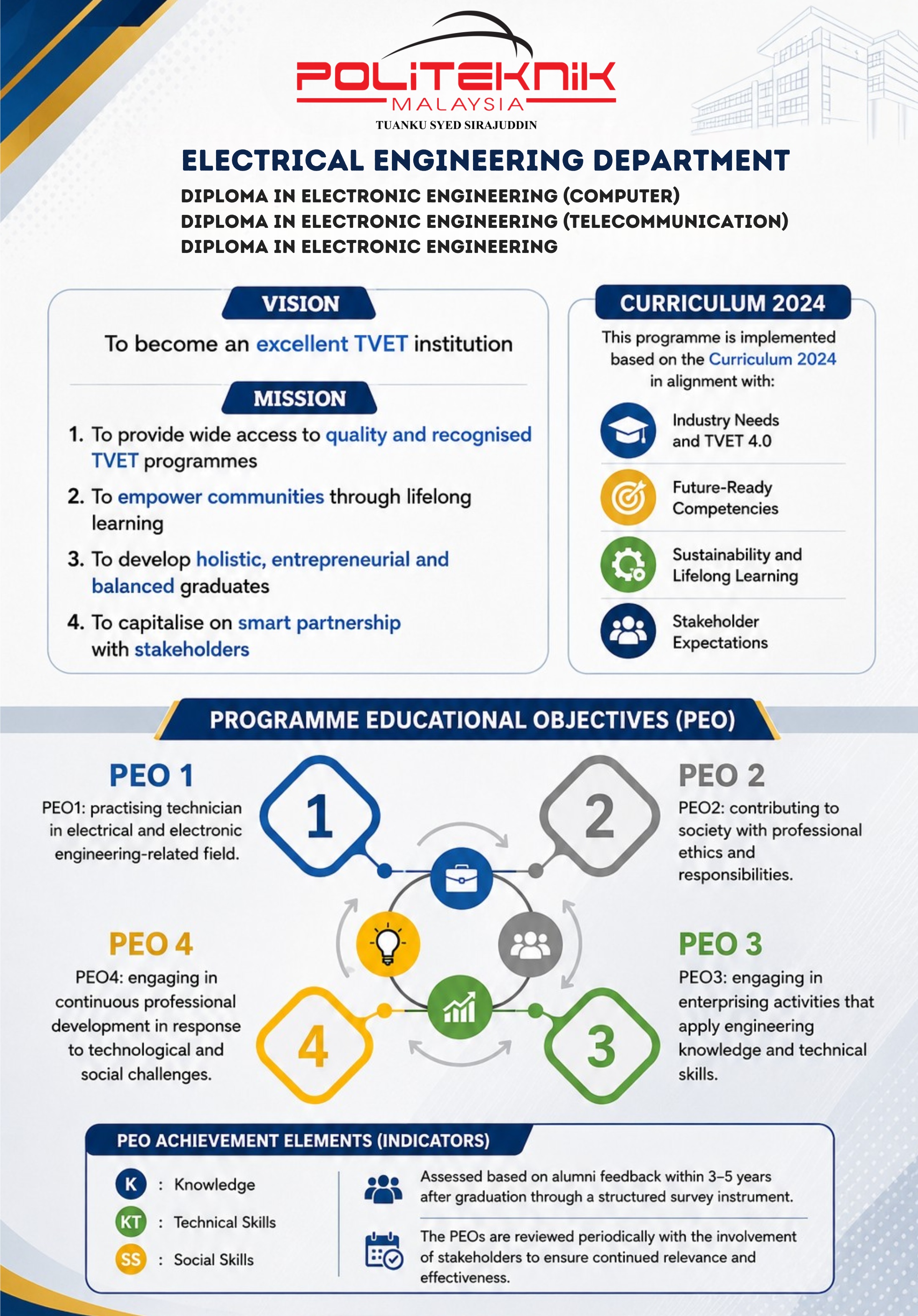
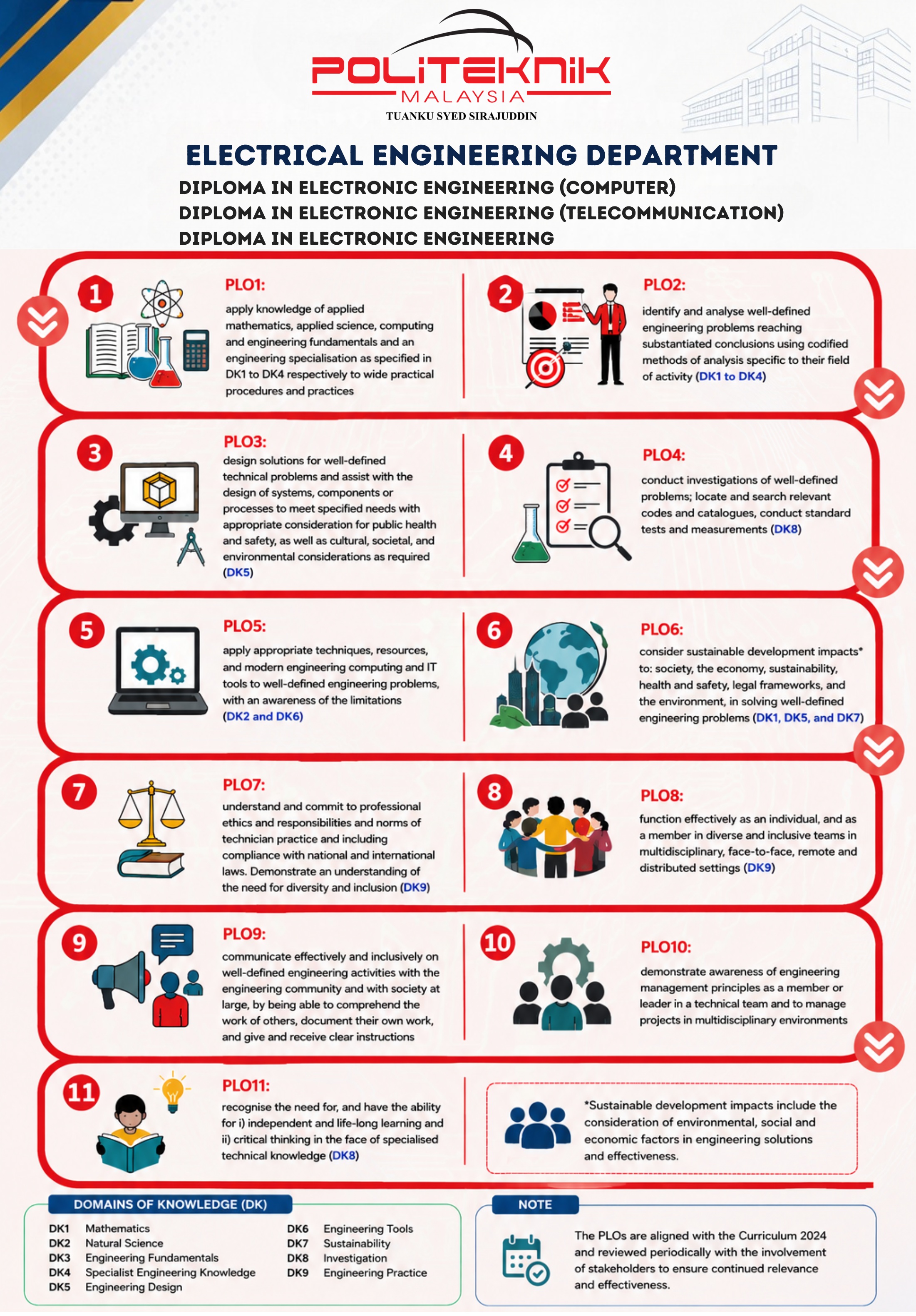
DIPLOMA IN ELECTRONIC ENGINEERING (COMPUTER) (DTK)
INTRODUCTION
The Diploma in Electronic Engineering (Computer) programme covers broad discipline of electronics engineering fundamentals, computer-based technologies and specialization. The computer-based technologies and specialization disciplines are comprised of computer system components which support the Industry Revolution 4.0, such as open-source software and programming tools, software-hardware interfacing application through the internet, computer system, computer vision, networking and integrated circuits design, fabrication and testing.
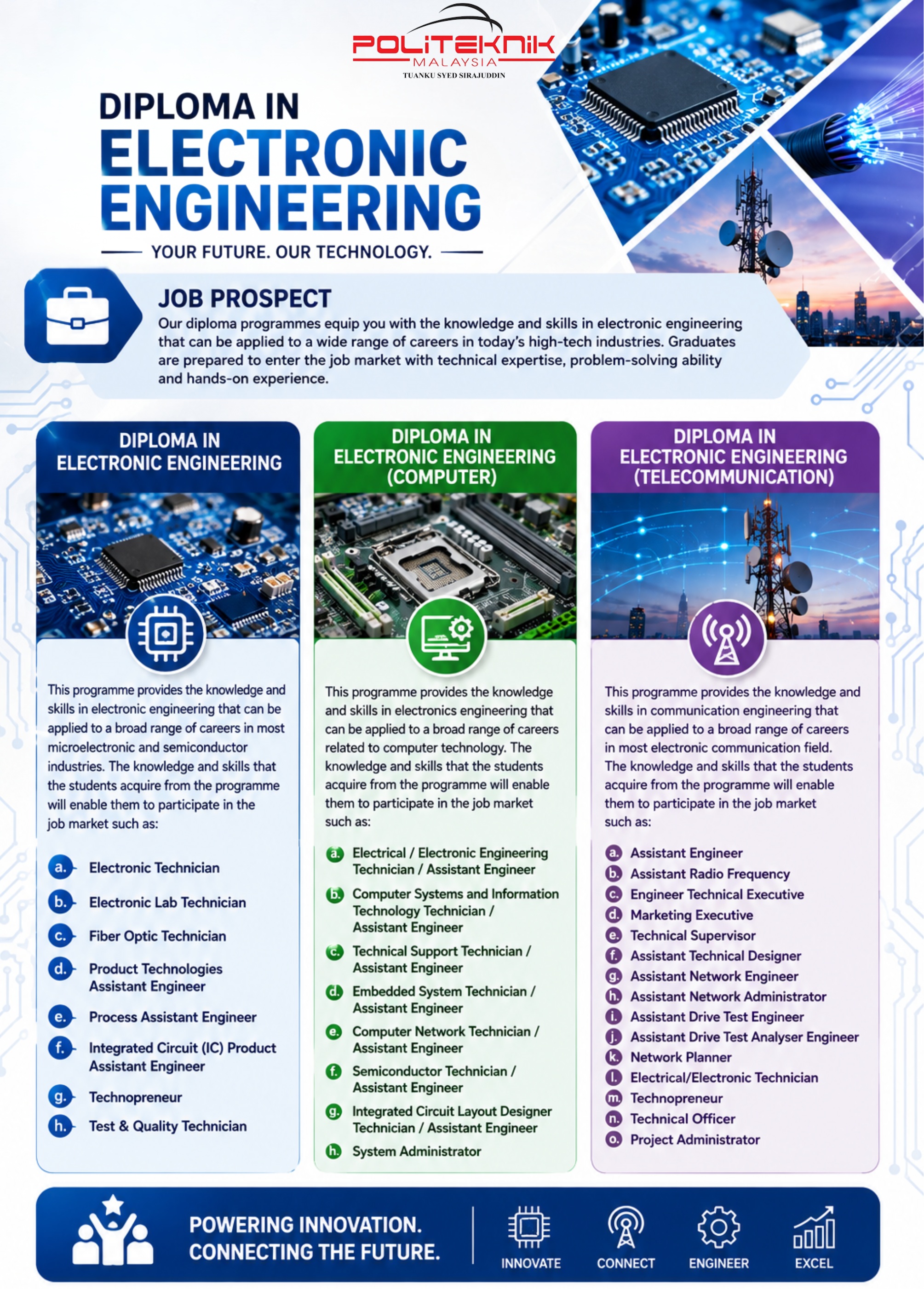
The graduates of the programme have the prospect of working in the electronics industry, computer-based technology industry and integrated circuit design, fabrication and packaging industry. The programme will produce balanced Technical and Vocational Education and Training (TVET) graduates who contribute to society ethically, engage in enterprising activities, continuously developing professionally and adapt to technology changes.
SYNOPSIS
The Diploma in Electronic Engineering (Computer) programme includes the discipline of electronics engineering fundamental courses, computer technologies-based courses and specialization courses. The engineering fundamental courses are semiconductor devices, electronic circuits, digital electronics, electrical circuit, electrical wiring, programming fundamentals, computer aided electrical drawing, and electronic computer aided design. The computer technology-based courses are comprised of embedded system applications, microprocessor, computer networking fundamentals, CMOS integrated circuit design and fabrication, computer vision programming, and internet of things devices applications. The specialization courses are database system, operating systems, computer system diagnosis and maintenance, computer vision programming, and final year project.

DIPLOMA IN ELECTRONIC ENGINEERING (TELECOMMUNICATION) (DEP)
INTRODUCTION
The Diploma in Electronic Engineering (Telecommunication) covers broad discipline of electronics engineering fundamentals, computer-based technology, and specialization. The computer-based technologies and specialization disciplines are comprised of software-hardware interfacing application through the internet, data networking, wired and wireless communication technology. Additionally, the program emphasizes practical skills essential for tasks such as system maintenance, installation, testing and troubleshooting.
The graduates of the programme will have the prospect of working in the electronics, telecommunications, and networking industry. The programme will produce balanced Technical and Vocational Education and Training (TVET) graduates who contribute to society ethically, engage in enterprising activities, continuously developing professionally and adapt to technology changes.
SYNOPSIS
The Diploma in Electronic Engineering (Telecommunication) programme includes the discipline of electronics engineering fundamental courses, computer technologies-based courses and specialization courses. The engineering fundamental courses are electrical wiring, semiconductor devices, measurement, electronic circuits, digital electronics, electrical technology, programming fundamentals, computer aided electrical drawing, electronic computer aided design, electronic equipment repair and fundamental communication system. The computer technology-based courses are comprised of computer vision programming, and internet of things devices applications. The specialization courses are microwaves engineering, data communication and networking, cellular communication system, fiber optic communication system and final year projects.
DIPLOMA IN ELECTRONIC ENGINEERING (DKE)
INTRODUCTION
The Diploma in Electronic Engineering programme covers broad discipline of electronics engineering fundamentals, computer-based technologies-based courses. The electronic engineering is the field of study which generally deals with the application of electronics towards designing, testing and development of circuitry and equipment for well-defined engineering activities. It requires the application of scientific and engineering knowledge and methods combined with practical skills in supporting well-defined engineering activities to prepare students for their future role in the industry.
The Diploma in Electronic Engineering graduates of the programme have the prospect of working in the electrical and electronic industries, computer-based technology industry and integrated circuit design, fabrication and packaging industry. The programme will produce balanced Technical and Vocational Education and Training (TVET) graduates who contribute to society ethically, engage in enterprising activities, continuously developing professionally and adapt to technology changes.
SYNOPSIS
The Diploma in Electronic Engineering programme includes the discipline of electrical and electronics engineering fundamental courses, computer technologies-based courses and discipline courses. The engineering fundamental courses are engineering wiring workshop, electrical engineering workshop, electronic engineering workshop, analogue circuit, digital electronics, electrical circuit 1 and 2. The computer technology-based courses are comprised of programming fundamentals, computer aided design, microprocessor and microcontroller and internet of things devices applications. Other discipline courses are, integrated circuit design and fabrication, fibre optic communication system, programmable logic control and final year project. The green technology elements are also incorporated in the curriculum to provide awareness towards the importance of the sustainable energy.